
Cr8Mo2SiV steel is used for cold extrusion dies, cold forging dies and deep drawing dies.
Cr8Mo2SiV steel is used for cold extrusion dies, cold forging dies and deep drawing dies.
Cr8Mo2SiV is a cold working die steel that complies with the GB/T 1299-2014 standard and is classified as an alloy tool steel. Its designation indicates that it contains approximately 8% chromium (Cr), and is supplemented with alloying elements such as molybdenum (Mo), silicon (Si), and vanadium (V). Internationally, it is often corresponding to Japan's Daikong Steel's DC53. This steel type was developed by modifying the traditional high-carbon high-chromium lathitic cold working die steel SKD11. By moderately reducing the carbon and chromium content, it inhibits the formation of lathitic eutectics, allowing M7C3 type carbides to precipitate finely and uniformly, thereby achieving better plasticity-toughness compatibility than the Cr12 series.
1. Chemical Composition and Alloying Elements' Effects
According to the GB/T 1299-2014 standard, the chemical composition (mass fraction) of Cr8Mo2SiV is: carbon C 0.95% - 1.03%, silicon Si 0.80% - 1.20%, manganese Mn 0.20% - 0.50%, phosphorus P ≤ 0.030%, sulfur S ≤ 0.020%, chromium Cr 7.80% - 8.30%, molybdenum Mo 2.00% - 2.80%, vanadium V 0.25% - 0.40%.
Each alloying element has a different mission: carbon provides the basic hardness and wear resistance; chromium ensures high hardenability and the precipitation of high-hardness carbides, which is the core defense line for wear resistance; molybdenum significantly improves the tempering stability and prevents high-temperature softening; vanadium refines the grains and pins the grain boundaries, significantly enhancing the anti-cracking ability; silicon plays a solid solution strengthening role, increasing the elastic limit. The smelting process typically uses an electric arc furnace + furnace outside refining (LF) + vacuum degassing (VD) technology to ensure the cleanliness of the steel.
2. Mechanical Properties and Heat Treatment Process
The delivery state is annealed, with a hardness of ≤ 255 HBW, facilitating mechanical processing. After heat treatment, extremely high hardness can be achieved:
Annealing: After holding at 850℃, controlled cooling to 550℃ (≤ 30℃/h) and then air cooling to remove forging stress and restore plasticity.
Quenching: After two preheats at 550℃ and 850℃, heating at 1020 - 1040℃, followed by oil cooling or air cooling, the quenching hardness can reach HRC 61 - 63. This steel has excellent quenching performance, even for large-section dies, it can obtain a uniform hardened layer, and the quenching deformation is extremely small.
Tempering: Two routes are provided - 180 - 200℃ low-temperature tempering twice, hardness HRC 62 - 63, suitable for high-hardness cutting tools; 520 - 530℃ high-temperature tempering twice, hardness can still remain HRC 62 - 64, at this time, the toughness is significantly improved, residual stress is effectively eliminated, and the dimensional stability is optimal.
Compared with the traditional Cr12MoV steel, after reasonable heat treatment, the die life of Cr8Mo2SiV can be increased by approximately 30%, and its anti-cracking and anti-cracking angle performance is significantly better than SKD11 type steel.
3. Typical Application Scenarios
Due to its "flexible and tough" performance characteristics, Cr8Mo2SiV is widely used in:
Precision stamping dies: high-precision stamping of body parts, structural parts, etc., with strong wear resistance at the cutting edge
Cold shearing dies, edge trimming dies, edge rolling dies: utilizing high wear resistance and dimensional stability
Drawing dies, twisting dies, gauges: relying on its micro-deformation characteristics after heat treatment
Cold extrusion dies, cold forging dies, deep drawing forming dies: suitable for plastic deformation of stainless steel plates, high-strength alloys, etc., which are difficult to process materials
Laser cutting processing forming dies: after high-temperature tempering, it can significantly reduce the residual stress of laser cutting, reducing the risk of cracking
4. Supply Forms
The supply forms of Cr8Mo2SiV on the market are very diverse to meet different die manufacturing needs:
Round Rod (Round Steel): The diameter range is wide, typically available from Φ10 mm to over Φ700 mm. The surface can be in black finish, polished, textured or precision-turned state.
Sheet/Flat Steel: Thickness ranges from 8 to 500 mm, width from 50 to 1500 mm. It can be machined on both sides or four sides for delivery.
Forgings and Modules: Forged blanks □200 to 500 mm. The maximum diameter of the forged disc can reach Ø1200 mm. Suitable for large mold blanks.
Other Shapes: Some suppliers can provide special sections such as steel pipes, steel strips, wire rods, hexagonal rods, etc.
Custom Processing Services: Include cutting and sizing, rough machining, customized heat treatment (quenching + tempering), surface treatment (black finish, polishing, sandblasting, turning/milling/finish), etc. Additional value-added services.
Delivery Status: Mostly delivered in annealed state (hardness ≤255 HBW). Also available for delivery in normalized state, machined state as per user requirements, and subject to 100% ultrasonic flaw detection.
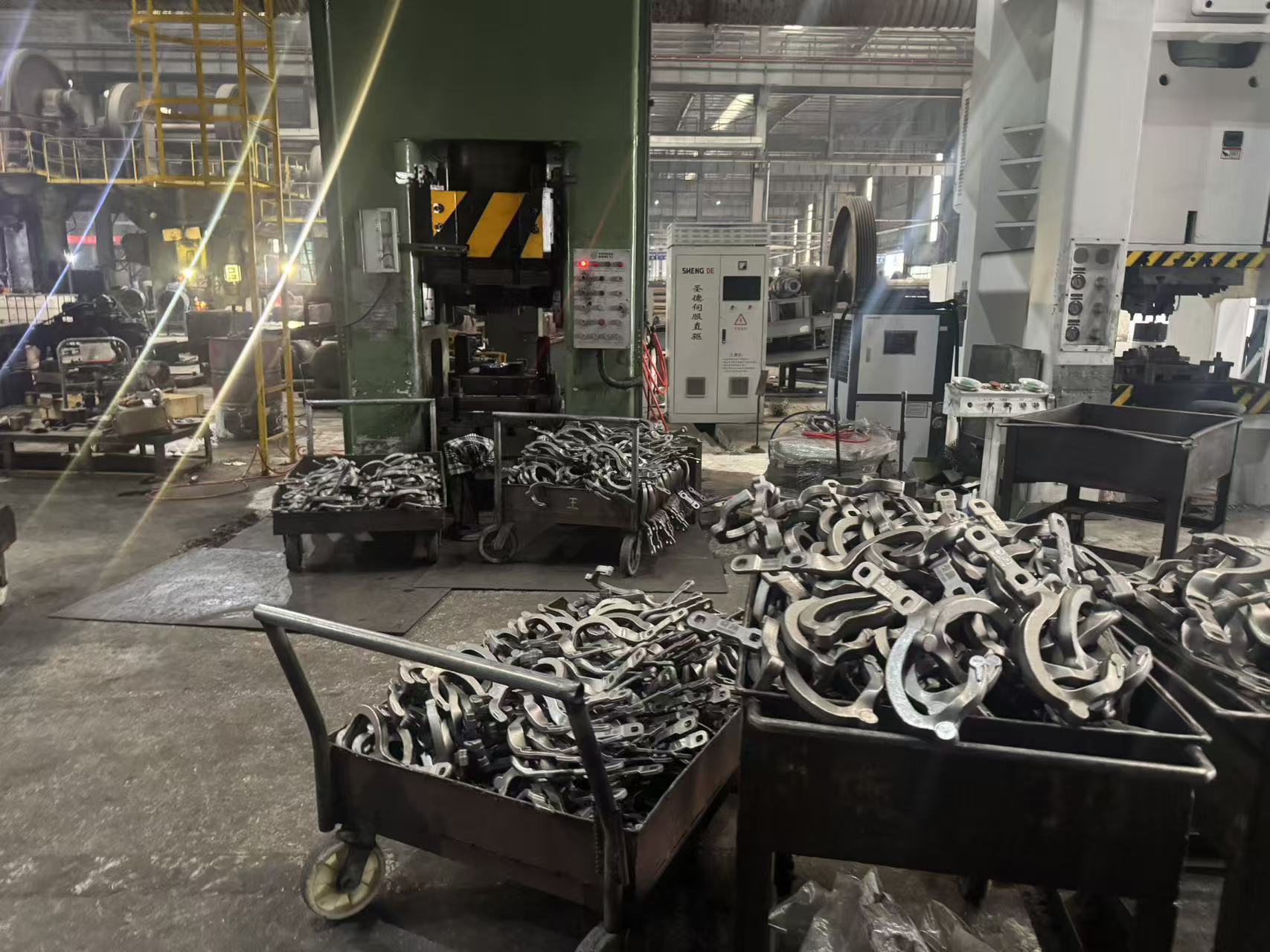
this is forging production line of yidu tongxin precision forging company
Send Inquiry



X
We use cookies to offer you a better browsing experience, analyze site traffic and personalize content. By using this site, you agree to our use of cookies.
Privacy Policy